
Dr. Shirazian takes a more careful approach, shaped by more than two decades of clinical experience and early training at the Jules Stein Eye Institute. He focuses on refining the fit until it feels right, rather than settling for an initial result.
Contact Lens Exams for Long-Term Comfort
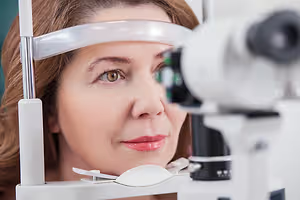
This is What Determines If Contact Lenses Will Work for You
Many contact lens issues come down to fit and compatibility with your eyes. Factors like corneal shape, tear quality, and how your eyes respond to lenses all play a role in whether contacts will feel comfortable and provide stable vision.
At MY OPTOMETRY, we evaluate these details carefully to determine not just the right lens, but whether contact lenses are truly a good option for you. That level of assessment is what allows many patients to succeed with contact lenses after struggling elsewhere.
What We Evaluate During Your Exam
Comfort, clarity, and long-term wear depend on how contact lenses interact with your eyes, not just your prescription.
We evaluate:
- The shape of your cornea determines how lenses sit on your eye
- Your tear film supports comfort throughout the day
- The health of your eye surface to reduce irritation
- How lenses move and settle with each blink
Minor differences in these measurements often explain why contact lenses have not worked well in the past.
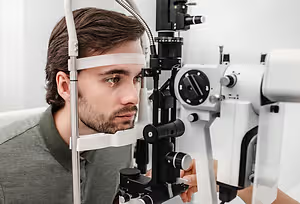

A More Precise Fitting Process
Contact lens success depends on refinement, not just initial measurements.
Lenses are tested and adjusted based on how your eyes respond in real time. Changes are made carefully to improve comfort, stability, and clarity. This process continues until the lenses feel natural and consistent.
Small adjustments often make the difference between lenses that are tolerated and lenses that truly work.
Trial Lenses and Follow-Up
You are not expected to commit to lenses that do not feel right.
Trial lenses allow you to experience how they perform in your daily routine. Comfort and vision are evaluated, and follow-up appointments are used to refine the fit if needed.
This process ensures that your lenses work well before you move forward.


You Still Have Options if Contact Lenses Have Not Worked Before
Many patients stop wearing contact lenses after dealing with dryness, irritation, or vision that never feels stable. In many cases, the issue is not the lenses themselves, but how they were fitted and how they interact with your eyes.
Some eyes require a more tailored approach. Below are common situations where contact lenses have not worked, and how they can often be improved:
Dryness is one of the most common reasons patients give up on contact lenses.
- Lenses may begin to feel uncomfortable after a few hours
- Vision can fluctuate as the tear film becomes unstable
- Eyes may feel irritated or tired by the end of the day
In many cases, this is related to how the lens interacts with your tear film. Certain lens materials and designs can help retain moisture and improve comfort, especially when the fit is adjusted carefully.
Some patients notice that their vision shifts throughout the day or never feels fully clear.
- Lenses may move too much with each blink
- Vision may seem sharp at first, then become blurry
- Small changes in position can affect clarity
This is often related to how the lens sits on the eye. A more precise fit can improve stability, allowing your vision to remain clearer and more consistent.
Standard lenses do not always perform well for more complex prescriptions.
- Vision may feel slightly off, even with the correct prescription
- Lenses may rotate, affecting clarity
- It may feel difficult to achieve consistently sharp vision
Specialized lens designs are available to address these issues, but they require careful fitting to perform properly.
Some patients have corneas that are not evenly shaped, which can make standard lenses ineffective.
- Vision may remain distorted even with glasses
- Standard contact lenses may not stay stable
- Comfort may be difficult to achieve
Specialty lenses, such as scleral lenses, are designed to vault over the cornea and create a smoother optical surface. This can significantly improve both clarity and comfort.
Some patients try multiple lenses and never find one that feels right.
Lenses may feel noticeable throughout the dayComfort may vary from one eye to the otherSmall irritations may persist
This often comes down to fine adjustments in fit. Small changes in lens size, curvature, or material can make a meaningful difference when evaluated carefully.
Dr. J. Shirazian O.D. Will Help YOu Find A More Reliable Approach
Dr. Foad J. Shirazian O.D. will help you find a more reliable approach by taking the time to understand how your eyes function and what has or has not worked for you in the past. As an experienced optometrist in Tarzana, he focuses on identifying the underlying issue and guiding you toward solutions that deliver consistent, long-term results. Rather than relying on temporary fixes, your care is approached with precision and attention so your vision feels stable and comfortable day to day.